Saturday, March 28, 2009

Earth Hour -- Finger, not the Moon


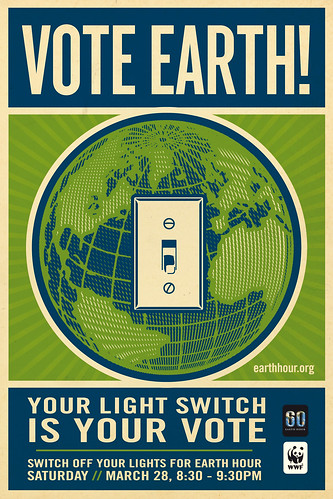
Earth Hour began in Sydney in 2007, when 2.2 million homes and businesses switched off their lights for one hour. This year, Earth Hour has been transformed into the world’s first global election, between Earth and global warming. In order to cast your vote for Planet Earth, you need to turn off your lights at the minimum between 8:30 PM and 9:30 PM today.

In December 2009, world leaders will meet at the Global Climate Change Conference in Denmark and discuss strategies that would replace the Kyoto Protocol. The WWF are trying to provide the results from today's "election" as evidence to the widespread urge across the world to take action against global warming.

While it is pretty straightforward to understand why WWF is promoting this effort, it may be worthwhile to examine the skepticism surrounding it.

1. Hour of no power will increase emissions:
Bjorn Lomborg, author of Cool It and The Skeptical Environmentalist argues that people resorting to candles during the Earth Hour will emit more carbon and pollute the air further, as candles are almost 100 times less efficient than incandescent light globes, and more than 300 times less efficient than fluorescent lights. If you use one candle for each extinguished globe, you're essentially not cutting CO2 at all, and with two candles you'll emit more CO2. Moreover, candles produce indoor air pollution 10 to 100 times the level of pollution caused by all cars, industry and electricity production.

There are some skeptics that say that the publicity done for the program will increase the emissions more than what can be saved in that one hour.

2. How can we measure the success of this effort?
This is not a controlled experiment, and it will not be possible to accurately determine the reduction in emissions or the number of people who participate in Earth Hour 2009.

However, there have been several efforts in progress to encourage people to measure their carbon footprint, so that individual lifestyle changes may have a positive impact on global emissions eventually. Ranging from online applications on Facebook that help track your footprint based on your lifestyle to workbooks that help monitor and control emissions based on your energy usage, there are plenty of resources you can tap into, if you're committed to making environment friendly decisions.

3. To-be or not to-be?
Many have been intrigued at the idea of measuring the impact of Earth Hour on emissions. If you're one of them, you'd be depressed to read this paper, which reports that individual lifestyle changes done during the Earth Hour are not effective in reducing emissions.

The Buddha said "Don't Mistake the Finger Pointing at the Moon for the Moon". It is important to recognize that this is a symbolic effort aimed at conveying a message. If more than a billion people across the world, from the Las Vegas strip to Sydney participate in an effort, it indisputably sends a message. Earth Hour is not poor symbolism, as long as it does not [and it will not] increase emissions drastically.

So, I will vote for Planet Earth, not by turning my lights off during that 1 hour, but through this post, for it is important that you and I recognize Earth Hour as the finger pointing at the moon, and send a message to our leaders that we need to act on global warming. From breathing to breezing through the street, everything we do emits carbon. It is not going to be easy to reduce emissions. Bjorn Lomborg argues in the same post, that "each nation should sign up to spend 0.05 per cent of its gross domestic product on low-carbon energy research and development. The total global cost would be 10 times greater than present spending, yet be 10 times less than the cost of the Kyoto Protocol on carbon emission reductions. This response to global warming is a realistic, achievable one."

Needless to say, there's many a mile between the finger and the Moon. Let the journey begin.

Monday, March 9, 2009

I am Pat, and You need a Nudge?

Happy St. Patrick's Day, but this post has little to do with that!

Human Impact (I) on the environment equals the product of population (P), affluence (A: consumption per capita) and technology (T: environmental impact per unit of consumption).

With growing global population, rise of the middle-class in India, China and in other emerging economies, and the use of unsustainable technology, the human impact on the environment is set to grow on an ongoing basis. Thomas Friedman illustrates the exponential growth of this impact with interesting examples, in his recent book "Hot, Flat and Crowded". One scenario that caught my attention was the impact of giving a light bulb to each of the billion people who will be born between now and 2020 -- 20 new 500-megawatt coal-burning power plants.

We need to change the ways [technology] in which we produce, consume and recycle products that we choose not to consume, in order to minimize the impact that we have on the environment. While incremental improvements in technology can be helpful, you can imagine that it may not be sufficient to reverse the impact growing population and affluence will have on the environment. So, what we need is a series of breakthrough innovations in several industries that will promote a more sustainable product life cycle.

Businesses are driven by profit, and they tend to resist creative destruction, as breakthrough innovations often come with risks. To promote sustainability, governments across the world have come up with regulations for several decades and have learnt that the best mechanism is to provide a market based "nudge" to businesses. Carbon Tax and Cap and Trade are popular nudges that have been debated extensively. Operative word -- extensive. Will dive deep into that debate in my next post. Signing off for now, Pat.

Sunday, March 8, 2009

Ford's Get Well Plan

Following up on my previous post, I tried to read about Detroit's reinvention/rescue plans. Ford emerged as the only beacon of hope. While I must admit that I did not follow any rigorous research procedure to follow the trend, I'd be surprised to learn otherwise, even if I had.

Incremental improvements are just as important as breakthrough innovations. Ford seems to have gotten this straight in its approach toward addressing the current crisis. Needless to say, this approach can help any company to its better days, especially when operations are aligned with the right vision. While Ford's share may not reflect this promise, it is very much a promise today -- untested, but full of potential.

Ford Explorer's 2011 model is on a diet plan to shed more than 150 pounds, with lighter weight steel. The plan also involves an "Ecoboost" engine that leverages sophisticated software from the 21st century and fuel efficiency techniques that date back to 1940s. It seems that these technologies could allow Explorer to supercede Toyota's Highlander Hybrid in highway fuel economy.

Even the best hybrid cars come at a premium today, and the return on investment is not clearly superior to that of regular cars that are otherwise fuel efficient and of high quality. There is a lot of buzz about electric cars, but it would be wishful thinking to hope that we will somehow be able to leapfrog both the technology and the cost differential at the same time. Given that the average car-buyer will try to get the most bang for her [based on Mark Penn's comments on car-buying soccer moms who represent the majority of car-buyers in the US, from his book Microtrends] buck, and that she will do so in a time when global sustainability will be put to test, with rising demand for oil and other commodities across the world, the demand for a fuel efficient automobile should be on the rise. This should be the case, at least for the next decade, assuming that we will have cost effective options that are also fuel efficient, by then.

There is a demand, and Ford seems to be eager to supply. Will the sale happen? That is anybody's guess at this time. All I can say is that Ford is full of promise today.

Sunday, February 1, 2009

Minding your own business

Jeff Jarvis argues in his book What Would Google Do? that Detroit should learn the power of collaboration and open design from Google. While there are challenges in implementing a cost-effective business model around collaborative automobile design and production, perceiving the concept with an end-of-the-pipeline mentality doesn't help either.

CarZen provides an excellent recommendation service that suggests cars that suit a buyer's needs. I was reminded of the innovative supply chain model that Dell pioneered during its initial days of glory -- letting customers make their own computer, and assembling the personalized computer through JIT inventory management. Detroit may not be eager to merge CarZen's recommendation service with Dell's personalized assembly line to make cars that serve unique customer needs.

Nevertheless, it is important that auto makers understand the business they're in. As Rishad Tobaccowala of ad giant Publicis points out, auto makers ironically are not in the business of making automobiles, but in the business of Navigation and Entertainment. Given that people need to navigate from point A to point B, and spend considerable time doing so, it should be a no-brainer that adding value in the process of fulfilling these needs should help differentiate and reap profits.

When McDonald's founder Ray Kroc asked a group of B-School graduates "What business do you think I'm in?", the graduates thought that he was just fooling around. Ray surprised them claiming that he was not in the business of flipping hamburgers, but in the business of real estate. He went on to detail that the focus of his business plan was to sell hamburger franchises, and that the location of those franchises was key to their success. We know that McDonald's doesn't make the best burgers in the world, nor does it provide the best dining experience. Yet, it takes some pondering to determine the actual business that a player is in. Recognition of the basics can be a profound experience, and can indeed be transformed into a black swan with the right execution strategies.

The idea of a personalized car may be romantic, to say the least, and may not be Detroit's silver bullet even in this era of personalization. Meeting energy efficiency goals stipulated through regulations screams "end-of-the-pipe" and may come at a cost [if not approached holistically]. It needs to be said that leaders identify themselves not by following the fads of the day, but by identifying their purpose for existence and by changing the way the world operates, not due to an urge to do so, but simply by following function.

Monday, November 24, 2008

Gotta be somebody's favorite

Understandably, Microsoft has rolled out an ad campaign to protect the brand from the unfavorable stereotype that Mac is so happily imposing on PC, and by extrapolation to everything Microsoft. Jerry Seinfield featured in an ad, which seemed like a futile attempt to attract attention. The idea to have PC users introduce themselves is novel and is by far the most effective ad in my opinion, that Microsoft has done to reconnect with its customers and prospects at the image level.

Today I came across an ad that hinted on one of the product positioning strategies that are in play.

You've got to be cool to appeal to kids. If there was any perception that PC is cool, Apple's ad campaign has definitely put that thought to rest. In the world of kids and parents, let us say that kids prefer Mac, because they think it is cool. PC's only hope would then be to appeal to parents. This ad revolves around various Windows Vista features that would help parents in controlling their child's internet usage, in terms of sites visited, hours spent browsing and much more.

You know what? Parents may find that "cool"!

Saturday, November 8, 2008

2.0

Well, the election is over, but it hasn't sunk in yet. For somebody who had been glued to every form of news about the primaries and the general election, a week-long hangover is to be expected. This is the first election I've followed this closely, and I must say, it has been educating and entertaining.

Many have had their chances to second-guess Obama's victory. Here are some of the common theories:

1. This was a vote against Bush, but not for Obama
2. This was a vote for the Democrat, but not necessarily for Obama
3. It's the economy, stupid
4. Obama ran a good campaign: clear vision, good execution and help from the media

As Jack Welch points out, vision and execution are both vital to success. We've learned much about the execution part of it, and I don't intend to bore you with more of the same [no pun intended!].

What about vision? Jack Welch stops with "Change" in his analysis. It didn't take too long for Hillary and the other front-runners to figure that out. There have been several contests [some in politics, some in business], in which somebody's message had been stolen by a competitor fair and square. Why couldn't anyone steal Obama's message this time? Is it because of his eloquence, or the use of the internet [layman for online fund-raising, social networking, recurring donations], or simply because all of his opponents made mistakes, while "somehow" he did not?

You may have guessed why this post is titled 2.0. I've seen some striking similarities in strategy between Web 2.0 and the Obama campaign, and that I assess is at the root of this victory.

Reach out to the entire web, to the edges and not just the center, to the long tail and not just the head.

Needless to say, the Obama campaign "had" to be innovative in fund raising, as it was open and shut that Hillary would charm the Democratic base easily. They definitely made some smart choices then, internet-based fund raising was one of those. The 50-state strategy also seemed like a tactic aimed at winning the primary. Little did the pundits know then, about the impact that strategy would have on Nov 4, 2008. In traditional red states such as Indiana and Virginia, Obama won by winning the blue electoral colleges and by losing the red electoral colleges by smaller margins, only because the campaign reached out not just to the head, but to the long tail as well.

Network effects from user contributions are the key to market dominance in the Web 2.0 era.

With social networking, this campaign broke new ground in enabling volunteers and supporters to organize among themselves.

So how did the Obama campaign figure this out? Did Facebook co-founder Chris Hughes and Google CEO Eric Schmidt give them the inside scoop on Everything 2.0? A campaign of this magnitude cannot be built to last and succeed, based on fragile tactics and strategies that suit the moment.

The Obama campaign introduced a new product called "Change" almost a couple of years ago. Choosing what to sell was the easy part, but how to sell is what Obama excelled in. While customers sensed the need for the product, several brands emerged during the primary season. The demand increased and so did the competition. Jack Welch is right, in that he says that the Obama campaign had a clear sense of vision. However, their vision was "to build a participative inclusive coalition". This vision and the campaign's ability to execute per this vision with strategies such as the 50-state campaign, social networking and internet based fund raising have been key to their success.

Perhaps, Barack Obama won this election because he was once a community organizer. After all, there are no coincidences.

Thursday, April 10, 2008

For the Love of Music

There are some movies that make a mark, even without a background score. If Life were a movie, it wouldn't make it to this column though. I grew on musicals and I guess it is only natural for me to wonder how emphatic and enlivened each emotion would be, if only life could be punctuated with a score.

Music may not have been something that I've done a doctorate in. I fancied learning the violin twice as a kid, and came to believe that I should own the instrument to play it. Only this time, I chose to learn to play the guitar. I guess the outcome is quite obvious :)

The music-lover has been in constant conflict with the conscientious neighbor that I am. Recently, they struck truce with the BOSE Portable iPod Speaker. Wow! What a difference it makes... I wouldn't have neighbors knocking on my door, eager to talk to me, while I'm peacefully enjoying my bath!